
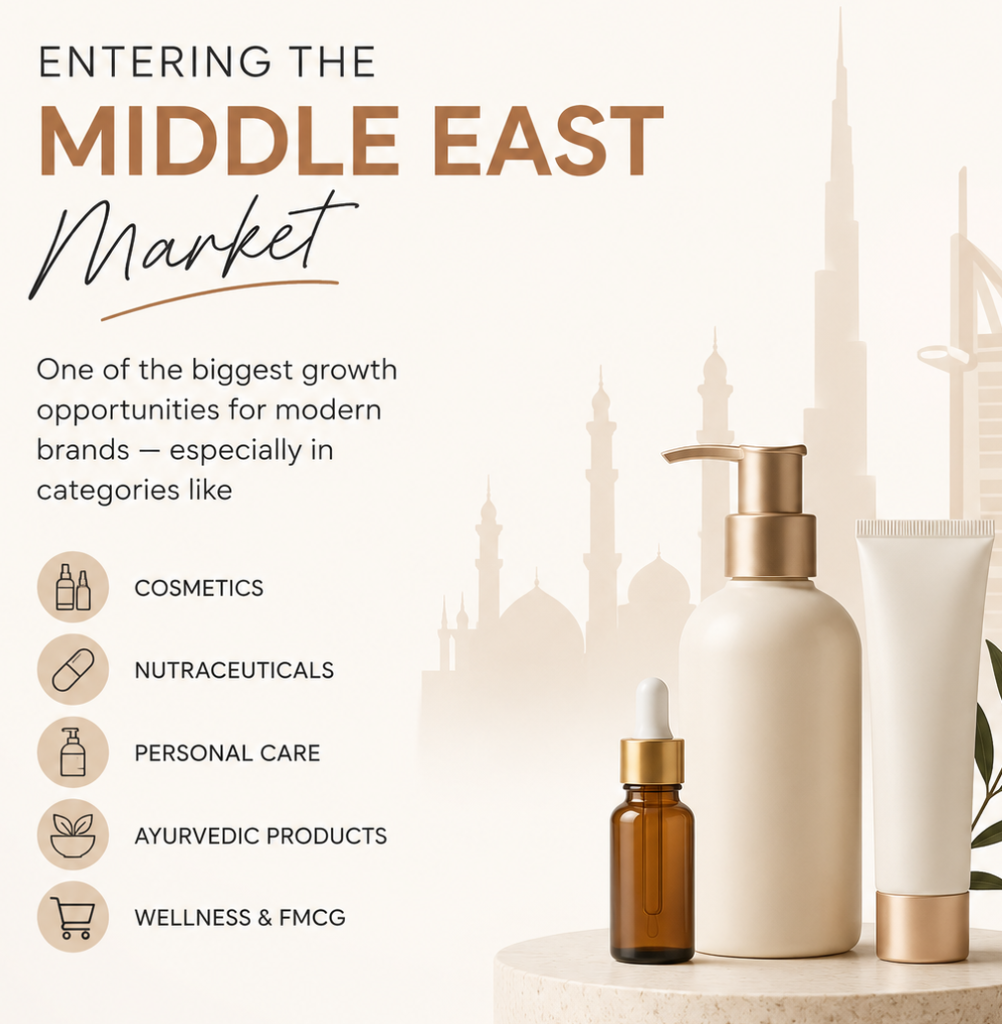
A few conflicting statements confuse businessmen when entering the UAE market. One of those is to enter the UAE first or KSA directly (Saudi Arabia).
You need to look into the following:
– Product category,
– investment capacity,
– distribution goals,
– regulatory readiness and long-term expansion strategy.
In this guide, we break down the differences between the UAE and Saudi Arabia to help you make a smarter market-entry decision.
Why are the UAE and Saudi Arabia important in the business world?
The UAE and Saudi Arabia are gateways to the GCC and MENA region.
-
-
The UAE is a fast-moving business ecosystem. The main benefits of the UAE include a global consumer base and easy-to-enter markets.
-
-
-
Saudi Arabia, with its massive population, strong purchasing power, and the fastest-growing consumer markets, is the perfect place to expand.
-
The ideal strategy is to explore both as the perfect marketing strategy. But the question still remains: which market to enter first? Let’s evaluate and decide on which market to enter first.
Let’s compare the market sizes of both markets.
UAE as a market:
The UAE population is 10 million, with 90% of the international consumer base. Its retail market is mostly tourism-driven. It means it is easier for a new brand to enter the market. Premium and niche brands are more in demand in the UAE. So if you are a niche brand, you can choose the UAE as your first entry.
The UAE is the best for:
-
-
Startup brands: Facilities such as tax advantages, strategic trade agreements, 100% foreign ownership, Fastrack Licensing, and dedicated incubators are the strongest attractions for a startup brand in the UAE.
-
-
-
Influencer-driven launches: The UAE is the best place for small, influencer-driven brands with high conversion rates and lower CAC.
-
-
-
Premium skincare: Products that are in high demand.
-
-
-
Wellness & Ayurvedic products
-
-
-
D2C brands: The UAE is well-suited for small brands and those that operate on a D2C business model.
-
-
-
Small-batch imports: Starting a small-batch import business in the UAE is highly accessible, thanks to low-capital options and local facilities that are a boon for businesses not interested in large-scale expansion.
-
Saudi Arabia (KSA) as a market:
-
-
KSA is obviously for sharks interested in the large-scale business expansion. With a considerably larger population than the UAE, it offers a large consumer base with varied tastes and preferences.
-
-
-
Higher long-term sales potential: If you are looking for a long-term expansion, KSA is your business destination.
-
-
-
Rapid retail and e-commerce growth: Universal internet penetration of approx. 99% and a large tech-savvy young population will help achieve these objectives.
-
-
-
If your product category falls within beauty, health, or FMCG, you can opt for a KSA launch.
-
Best For:
-
-
Large-scale expansion
-
-
-
Established brands
-
-
-
Mass-market FMCG
-
-
-
Long-term regional distribution
-
-
-
Retail-heavy business models
-
Decision based on Product Registration & Regulatory Complexity
UAE registrations are faster and more flexible. The UAE is generally considered easier for first-time product launches.
Let’s explore the advantages of launching in the UAE first:
-
-
Faster approval timelines: Faster registration approval is a big plus of launching in the UAE first.
-
-
-
Simpler documentation process: The documentation process is usually simpler and less complex than the KSA launch documentation.
-
-
-
Easier importer/distributor setup: The UAE provides you with a complete setup required for import-export and distribution of goods.
-
-
-
Business-friendly ecosystem: You will find the ecosystem easy to operate and distribute your products.
-
-
-
Ideal for pilot launch: The UAE always welcomes and supports new brand launches and operations, and provides the perfect base for
-
Some of the authorities in the UAE are:
-
-
Dubai Municipality
-
-
-
MOHAP
-
-
-
ESMA/ECAS is also common, but it depends mainly on the product type.
-
Average Launch Timeline:
If you are looking for a quick launch, it usually takes 2 to 8 weeks in the UAE.
Launching in KSA
Registrations are structured in KSA but require more regulations.
Brands that are thinking of launching it on a large scale and for the long term could be a better choice.
Advantages:
-
-
Brands gain credibility because the launches in KSA require more documentation.
-
-
-
Similarly, retail acceptance of the brands is better after launch in KSA.
-
-
-
The population is large; hence, any brand can reach a higher number of consumers (larger consumer penetration)
-
Challenges:
-
-
It requires more documents and time. Usually, new brands are not complete with all the documents. Getting the documents takes more time and involves extra cost.
-
-
-
Arabic compliance wants all the documents to be perfect and is critical.
-
-
-
SFDA approvals are a long process, and you need to be patient.
-
-
-
Local representation is often needed. You need to develop a small office or a warehouse that physically represents you in the country.
-
Authorities: KSA regulatory authorities are below:
-
-
SFDA (Saudi Food & Drug Authority) – For food items and nutraceutical items.
-
-
-
SASO – This authority ensures that your product is safe and of quality.
-
-
-
In addition, municipal approval is a must.
-
The average launch time is 2-4 months, which is longer than that of the UAE.
Now, as we already know where to launch first based on the documents needed and the time required, let’s look into the cost involved in the launch.
Launch in the UAE: Cost
Usually, lower upfront investment. As discussed earlier in this blog, the cost involved in launching the business is on the lower side.
Typical Expenses:
Common expenses involved are product registration, import license/distributor support, warehousing, marketplace onboarding, and digital marketing.
If you are launching a business and want to test it in the market, you can start from the UAE, as the cost involved in launching the business is on the lower side.
Saudi Arabia Launch Costs
Typically higher due to the extra documents required. The following are the documents required.
-
-
Compliance documentation, local partnerships, warehousing requirements, Arabic packaging adaptations, and distribution setup.
-
Ideal For:
If your brand is already established and you are looking for a KSA launch, it is better for a large-scale business. KSA is a better choice for long-term investments.
E-Commerce & Retail Opportunities
If your company is an e-commerce company, KSA will work better for you. Looking for quick retail sales, choose KSA.
UAE
The UAE is a highly digital platform and prefers businesses to be digital.
Popular digital platforms in the UAE are Amazon UAE, Noon, TikTok Shop, pharmacy chains, and boutique retailers.
The UAE is the best for brands that are influencer-driven; in social commerce; with premium positioning; and that facilitate quick customer feedback.
Saudi Arabia
KSA’s e-commerce growth is massive and rapidly evolving in Saudi Arabia. If you are looking for e-commerce growth, Saudi Arabia could be your first launch destination.
Popular channels used in Saudi Arabia are ‘Amazon.Sa’, Nahdi, Danube, and large supermarket chains.
Like the UAE, Saudi consumers are also highly active online, especially in beauty, personal care, supplements, and health-focused products.
Consumer Behavior Differences
UAE Consumers are different than KSA consumers and behave differently. They are familiar with international brands. Consumers in the UAE are premium-product-oriented and enjoy trying new brands.
Saudi Consumers: Let’s discuss the characteristics of Saudi consumers. Brand loyalty is strong and mostly family-oriented purchasing behavior. They have high repeat-purchase potential and larger volume consumption.
Let’s decide on which market to choose first. You need to consider the above points before launching the products in the markets.
Choose the UAE as your launching pad if:
If you are a start-up, you can go for the UAE as your launching pad. There are many benefits of launching in the UAE. Your brand will get quicker approvals. If your product is new and you want to test it, you can choose the UAE as your launch country. You are testing market response and an easier influencer market; with a limited launch budget, the UAE is the better option. Later, you can plan to expand gradually across GCC. The UAE works extremely well as a gateway market.
When to choose Saudi Arabia?
Saudi Arabia is a different market in terms of the following: You already have a manufacturing scale, strong investment capacity, and aggressive retail expansion. If you already have market data about your brand and want a large-scale business, Saudi Arabia is the better choice.
Choose Saudi Arabia if you are looking for serious growth for your business.
Conclusion!
There is no universal “better” market between the UAE and Saudi Arabia — only the market that fits your brand stage and expansion goals.
-
-
The UAE is a better choice for start-ups. It offers benefits like speed, flexibility, and lower entry barriers that help in saving time and cost and help expand the company smoothly.
-
-
-
Saudi Arabia could be your choice if you are looking for volume, scale, and long-term growth potential.
-
The strategy for becoming a successful brand in the region is to launch in the UAE first and then expand slowly in Saudi Arabia and the wider MENA market. Chosen smartly, these markets can become a powerful launchpad for your brand.
Need further assistance?
ATOZ Health can help your brand with product registration & approvals, UAE & KSA compliance, distributor onboarding, retail & e-commerce expansion, branding & market-entry strategy, and MENA distribution support.
ATOZ specializes in launching nutraceuticals, skincare, Ayurvedic products, wellness products, and FMCG goods. The right regulatory and distribution partner can help in a hassle-free launch and mitigate market-entry risks.